LTE Connectivity
The Web3 Pi UPS accepts an optional plug-in LTE-M module (Cat-M1 / NB-IoT cellular) that gives the UPS its own cellular link — completely independent of your home network and mains power. When the power goes out and your router goes dark, the UPS keeps reporting. The module ships with a pre-installed global IoT SIM and an included data plan — no SIM card, mobile contract, or carrier configuration needed (the SIM also carries the device's identity, so don't swap it).
With the module fitted you get:
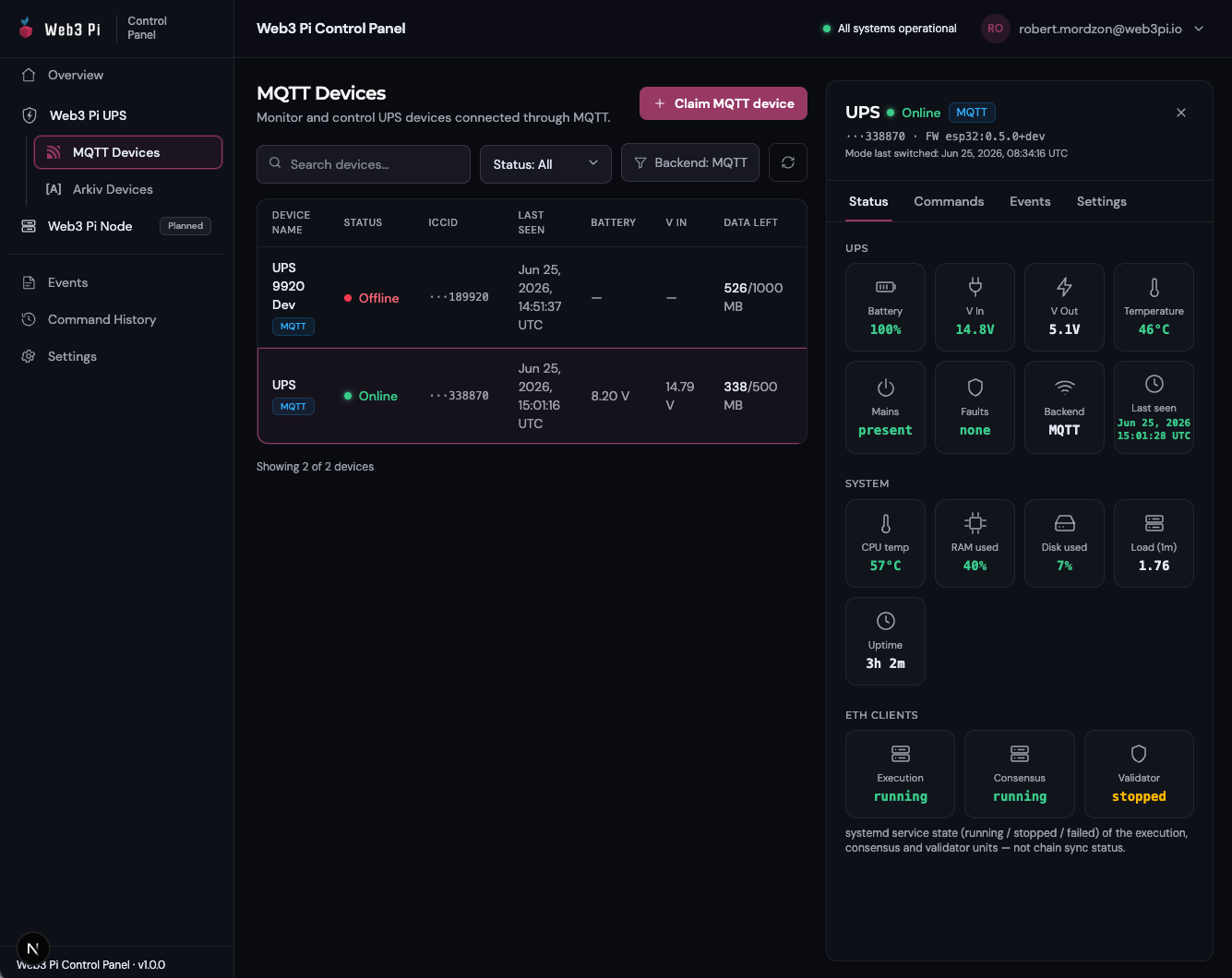
- Remote monitoring — telemetry (battery, inputs, host state) uplinked roughly every 30 seconds, wherever the device is.
- Instant alerts — power-state changes (mains lost/restored) and faults are pushed immediately, not on the next 30 s tick.
- Remote commands — reboot or shut down the host, power-cycle the output, trigger a beep, and start/stop/restart the Ethereum clients running on the Pi.
- Remote firmware updates — both the modem module and the UPS controller can be updated over the air from the web panel.
- No network setup — the module is an outbound-only client, so it works behind carrier-grade NAT. No public IP, port forwarding, or VPN required.
Backend Modes
The module reports to one of three backends — exactly one active at a time. MQTT is the default and recommended mode: zero configuration, and the full web panel experience. HTTP and Arkiv are alternatives for specific needs. All three authenticate every message; MQTT and Arkiv are always encrypted, and HTTP mode adds encryption when you use HTTPS.
| Mode | Where your data goes | Best for |
|---|---|---|
| MQTT (default) | Web3 Pi cloud + web panel | Most users — zero-config remote monitoring and commands |
| HTTP | Your own server — HTTP mode | Self-hosters who want data on their own infrastructure |
| Arkiv | Web3 Pi's Arkiv-compatible blockchain — Arkiv mode | Tamper-evident records for special/compliance needs |
MQTT and Arkiv devices are fully managed in the web panel. In HTTP mode your own server is the backend — the panel can still list such a device, but its live data and commands go through your server.
Switching Modes
Modes are switched on the device itself, from the OLED menu:
- On the Home screen, hold LEFT for 2 seconds to open the menu.
- Select Network (requires the LTE-M module — shows NO MODEM otherwise).
- Select Mode, then pick MQTT, ARKIV, or HTTP —
*marks the active mode. - The setting is saved and the LTE-M module reboots into the new mode.
The choice persists across reboots and power loss. The module reboot only pauses telemetry for roughly half a minute to two minutes while it reconnects — power to the Pi and battery backup are handled in hardware and are never interrupted.
Without the Module
The LTE-M module adds remote visibility; it is not required for protection. Without it, the UPS still provides the full power path and battery backup, the OLED display, buttons, buzzer alarms, and the local settings menu — plus telemetry, event logging, and graceful shutdown for the connected Pi over the single USB-C cable (see Host Integration).